
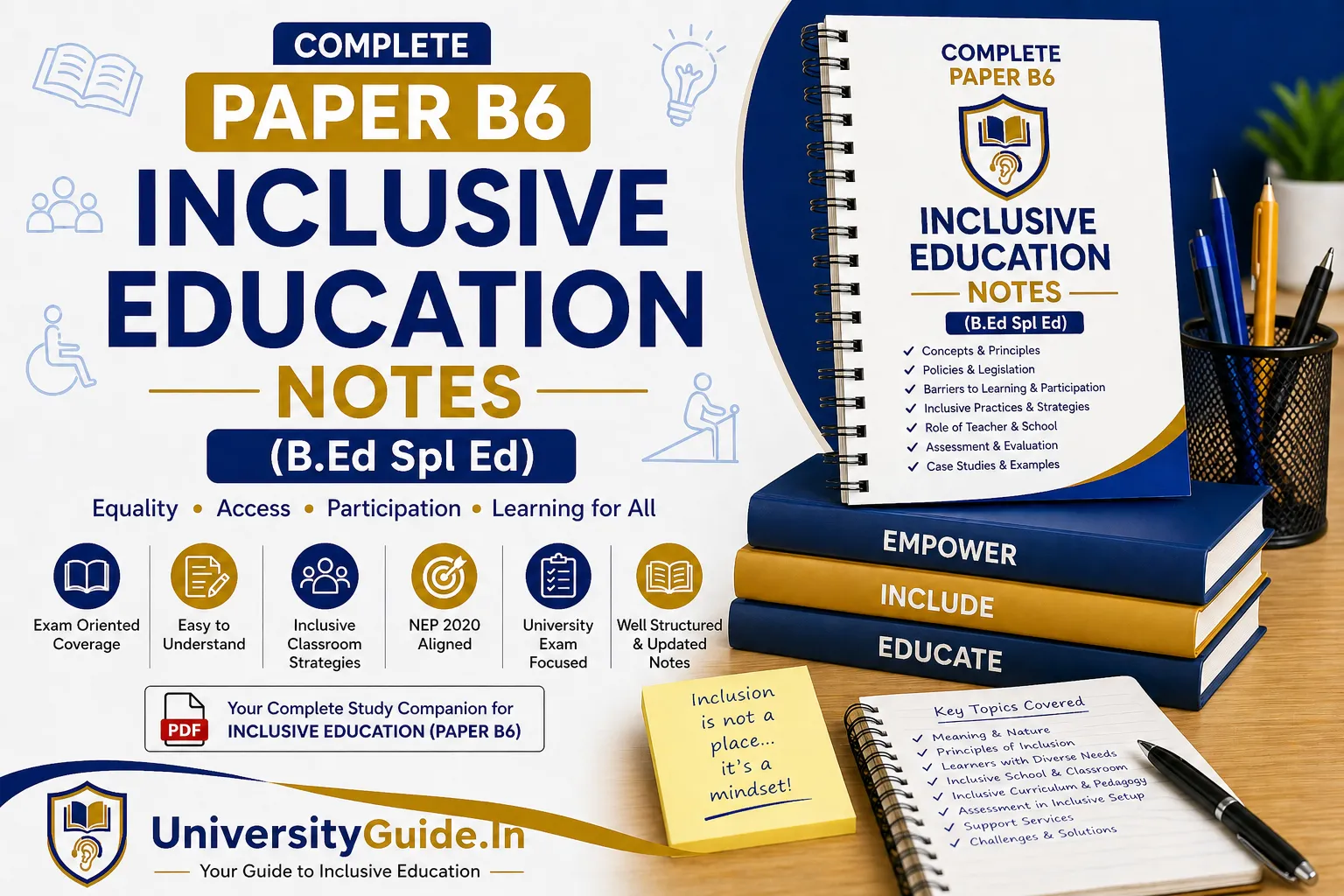
Welcome to your ultimate study guide for Semester 2. If you are pursuing a B.Ed in Special Education under the Rehabilitation Council of India (RCI), you will quickly learn that one subject forms the philosophical backbone of your entire career: Inclusive Education. Studying from detailed Paper B6 Inclusive Education Notes is critical not just for passing your university exams, but for clearing the CTET exam, where this specific topic carries a guaranteed 5 marks.
Inclusive education is no longer just a trend; it is a legal mandate in India. Gone are the days when children with disabilities were hidden away in isolated special schools. Today, the goal is to bring every child, regardless of their physical, mental, or sensory challenges, into the mainstream regular classroom.
In this comprehensive, 2000-word guide, we will break down the core units of the RCI syllabus. We will explain the historical journey from segregation to inclusion, simplify the complex legal acts (like the RPWD Act 2016), and provide you with exact strategies to manage an inclusive classroom. Let us dive into your Paper B6 Inclusive Education Notes so you can score top marks.
Unit 1: The Journey to Inclusion
To truly understand inclusion, you must understand what came before it. A guaranteed 16-mark question in your university exam is to explain the difference between Segregation, Integration, and Inclusion. Examiners look for these exact definitions in your Paper B6 Inclusive Education Notes.
1. Segregation (The Old Approach)
In this system, children with disabilities are completely separated from normal children. A deaf child goes to a “Deaf School,” and a blind child goes to a “Blind School.” While they get specialized attention, the major disadvantage is that they grow up isolated from the real world. Society begins to view them with pity or fear because they are hidden away.
2. Integration (The Middle Step)
In the 1990s, the government introduced integration. Here, children with disabilities were admitted to regular schools. However, the school did not change its rules or environment. The burden was entirely on the disabled child to “fit in.” If a child in a wheelchair could not climb the stairs to the 2nd-floor classroom, it was the child’s problem, not the school’s problem. Integration failed because it demanded that the child change, not the system.
3. Inclusive Education (The Modern Mandate)
Inclusive Education is the ultimate goal. In this system, the school changes to fit the child. It is a human-rights approach that states every child has the right to learn in the same classroom as their neighbourhood peers. If a child is in a wheelchair, the school builds a ramp. If a child is deaf, the school hires a sign language interpreter. Inclusion values diversity and believes that normal children also benefit by learning empathy and cooperation.
Unit 2: Legal and Policy Perspectives
A special educator must know the law. Without legal backing, inclusion is just a good idea. Your Paper B6 Inclusive Education Notes must contain a thorough understanding of these three major Indian policies.
1. Right to Education (RTE) Act 2009
The RTE Act made elementary education a fundamental right. It mandated free and compulsory education for all children aged 6 to 14. However, for children with benchmark disabilities, an amendment was made to extend this age group from 6 to 18 years. It also legally prevents any government or government-aided school from denying admission to a child on the basis of their disability.
2. Rights of Persons with Disabilities (RPWD) Act 2016
This is the most important piece of legislation in special education history. It replaced the old PWD Act of 1995. You must memorize these key points:
- It expanded the recognized list of disabilities from 7 to 21. It added new categories like Specific Learning Disabilities (Dyslexia), Autism Spectrum Disorder, Acid Attack Victims, and Multiple Sclerosis.
- It mandated that all educational institutions funded or recognized by the government must provide inclusive education.
- It increased the reservation in government jobs for persons with disabilities from 3% to 4%.
- It introduced severe financial penalties and jail time for anyone who discriminates against or verbally abuses a person with a disability.
3. National Education Policy (NEP) 2020
The NEP 2020 strongly advocates for full inclusion. It proposes the creation of “School Complexes” where resources (like special educators and speech therapists) are shared among a cluster of neighborhood schools. It also emphasizes the use of assistive technology and teaching in the mother tongue to remove language barriers.
Unit 3: Barriers to Inclusive Education
Why is inclusion so difficult to implement in India? In this section of your Paper B6 Inclusive Education Notes, we identify the roadblocks. If you are asked this in an exam, always divide your answer into these three categories.
A. Attitudinal Barriers
This is the biggest hurdle. Society, parents, and even regular teachers often hold negative attitudes. General teachers might feel, “Why is this deaf child in my math class? They are slowing down the normal students.” Parents of normal children might complain that a child with Autism will distract their child. Overcoming this requires massive community awareness and teacher sensitization programs.
B. Physical and Architectural Barriers
Most old school buildings in India are structurally disabling. Classrooms are on the third floor with no elevators. Bathrooms are too small for a wheelchair to enter. Corridors have steps instead of ramps. The lack of acoustic treatment in classrooms makes it impossible for a child with a hearing aid to listen to the teacher because of the echoing noise.
C. Curricular and Instructional Barriers
The standard state board syllabus is rigid. It relies heavily on reading and writing. If a regular teacher only uses the “chalk and talk” lecture method, children with visual or hearing impairments will automatically fail. The lack of adapted textbooks, braille materials, and flexible examination rules forms a massive barrier to inclusion.
Unit 4: Strategies for Creating Inclusive Classrooms
As a special educator, you will be appointed as a “Resource Teacher” in an inclusive school. Your job is to help the regular teachers manage children with disabilities. Your Paper B6 Inclusive Education Notes should highlight these practical, classroom-tested strategies.
1. Peer Tutoring
Children learn best from other children. In peer tutoring, a high-achieving normal student is paired with a student with a disability. For example, during a science experiment, the normal student explains the steps to the deaf student using simple gestures, while the deaf student performs the physical task. It builds friendship and reduces the burden on the teacher.
2. Co-Teaching Models
In a true inclusive setup, the General Education Teacher and the Special Educator work together in the same classroom. This can happen in several ways:
- One Teach, One Assist: The general teacher delivers the history lecture, while the special educator walks around the room, helping the child with ADHD stay focused or explaining a hard word to the deaf child.
- Station Teaching: The classroom is divided into learning centers. Students rotate between the general teacher’s table and the special educator’s table.
3. Universal Design for Learning (UDL)
You studied this in Curriculum Designing, but it is equally vital here. UDL means planning your lesson from day one assuming that there will be diverse learners in the room. You provide multiple ways of presenting information (video, audio, text) and multiple ways for students to show what they know (written test, oral presentation, drawing a diagram).
4. Individualized Education Program (IEP)
Even in a classroom of 40 normal students, the one disabled child must have an IEP. The special educator tracks their specific goals and ensures that the general teacher is providing the necessary accommodations (like giving the child extra time during the final exam).
Top 5 Important Exam Questions for Paper B6
When preparing for your Semester 2 RCI exams, make sure you write out full answers to these highly repeated past paper questions:
- Differentiate between Segregation, Integration, and Inclusive Education. Why is Inclusion the best model? (16 Marks)
- Discuss the key features of the Rights of Persons with Disabilities (RPWD) Act 2016 regarding education. (16 Marks)
- Identify the major attitudinal and physical barriers to inclusive education in the Indian context. Suggest remedies to overcome them. (16 Marks)
- Write a short note on Peer Tutoring and its benefits in an inclusive classroom. (5 Marks)
- What is the role of a Special Educator in a regular mainstream school? Explain with examples. (16 Marks)
Conclusion
Inclusive Education is not just a chapter in a textbook; it is a movement for social justice. By mastering the concepts in these Paper B6 Inclusive Education Notes, you are preparing yourself to be an advocate for children who have historically been left behind.
When you sit for your exams, always remember to use strong, professional vocabulary. Do not use words like “handicapped” or “dumb.” Use “Children with Special Needs (CWSN),” “Hearing Impairment,” and “Accommodations.” Quoting the RPWD Act 2016 in your long answers will instantly impress the examiner and secure your ‘A’ grade.
For more detailed study materials, previous year question papers, and CTET preparation guides, make sure to browse the other categories on our portal. Share this guide with your classmates and happy studying!