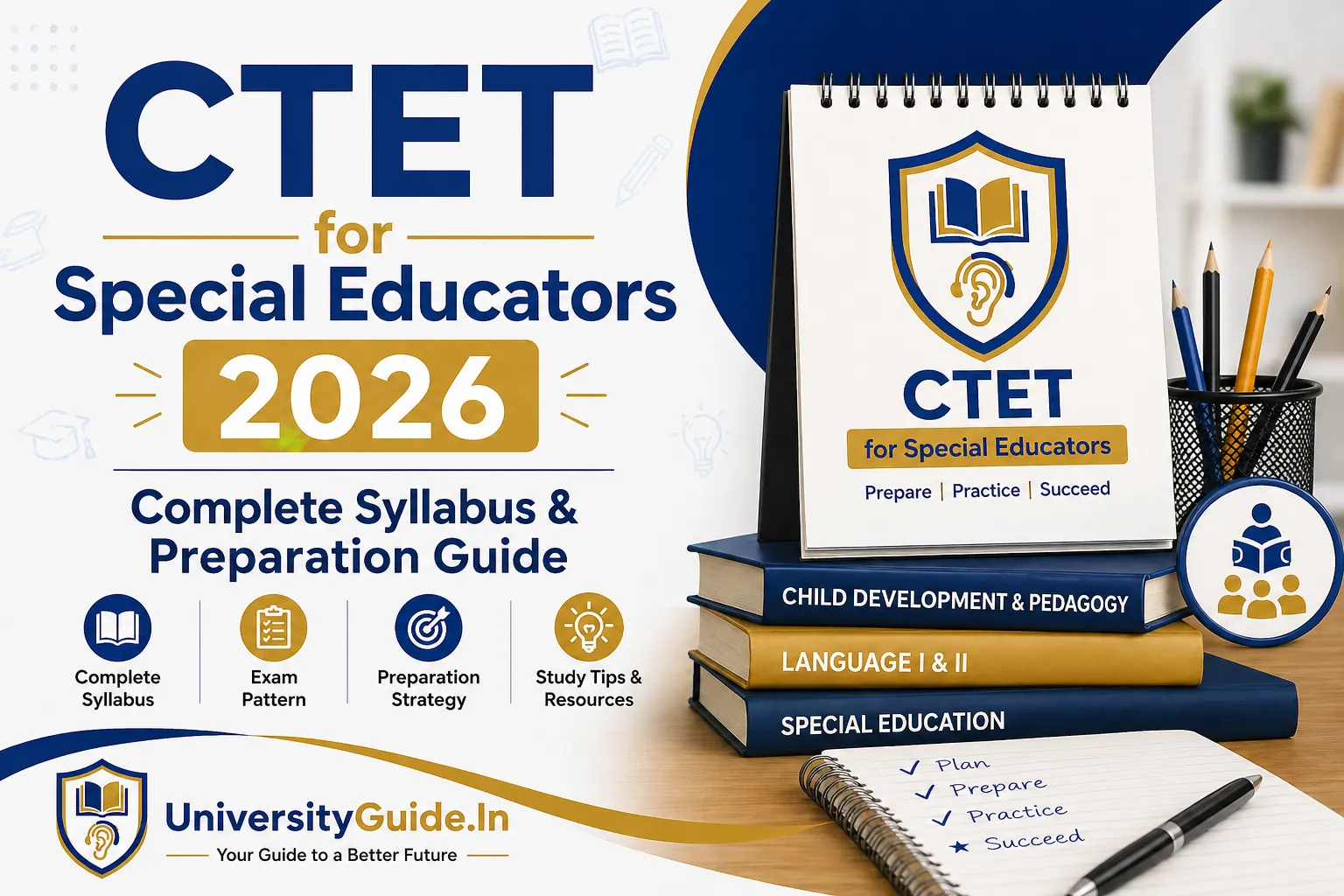
Are you pursuing a B.Ed in Special Education and feeling confused about the Central Teacher Eligibility Test? You are not alone. Every year, thousands of students ask the same question: “Is there a separate CTET for Special Educators?”
The straightforward answer is no, there is no separate paper. However, passing the general CTET exam is absolutely mandatory if you want to secure a high-paying government teaching job. As the government strictly enforces the National Education Policy (NEP 2020), inclusive education has become a priority, meaning the demand for certified special educators in central and state schools is higher than ever.
In this comprehensive, 2000-word guide, we will break down everything you need to know about CTET for Special Educators. We will cover the eligibility criteria, the exact exam pattern, how your Rehabilitation Council of India (RCI) syllabus helps you pass, and a step-by-step preparation strategy.
1. Why is CTET for Special Educators Mandatory?
Before we discuss how to study, you must understand why you need to write this exam. The CTET for Special Educators is your gateway to government jobs. The National Council for Teacher Education (NCTE) has made it a strict rule that anyone applying for the post of a Trained Graduate Teacher (TGT) must hold a CTET certificate.
Here are the top government sectors where passing this exam is a strict requirement:
- DSSSB (Delhi Subordinate Services Selection Board): Delhi government schools recruit thousands of “TGT Special Education Teachers” every year. You cannot even fill out the application form without a valid CTET Paper 2 certificate.
- KVS (Kendriya Vidyalaya Sangathan): KVS hires special educators to support inclusive classrooms across India. A CTET pass certificate is a primary eligibility condition.
- NVS (Navodaya Vidyalaya Samiti): Similar to KVS, NVS requires special educators to have cleared the central eligibility test.
- State Government Jobs: While many states conduct their own TET (like AP TET or UPTET), the CTET certificate is widely accepted as a valid replacement in most states.
To learn more about the salary packages and job notifications, you can read our detailed guide on Career Scope and Government Jobs after B.Ed Special Education.
2. Eligibility Criteria: Who Can Apply for CTET for Special Educators?
Many students wait until they complete their two-year B.Ed course before applying for CTET. This is a huge mistake. According to the latest ruling by the NCTE and the Supreme Court of India, you do not need to wait until your final year.
Pursuing Candidates are Eligible
If you have simply taken admission into an RCI-approved B.Ed Special Education course (even if you are in Semester 1), you are legally eligible to apply for and write the CTET exam. If you pass, your certificate will be 100% valid for a lifetime.
Basic Educational Qualifications
- You must hold a Graduation degree (B.A., B.Sc., B.Com., or B.Tech) with at least 50% marks.
- You must be pursuing or have completed a 2-year B.Ed in Special Education (HI, VI, ID, etc.) recognized by the Rehabilitation Council of India (RCI).
3. Which Paper to Choose? Paper 1 vs. Paper 2
This is where students make the most common mistake in the CTET for Special Educators application form. The CBSE conducts two different papers on the exam day. You must choose the right one based on your qualification.
CTET Paper 1 (For Classes 1 to 5)
Paper 1 is designed for Primary Teachers (PRT). However, following a recent Supreme Court judgment, candidates holding a B.Ed degree are no longer eligible for primary teacher posts. Therefore, B.Ed Special Education students should not apply for Paper 1. (Note: Only students doing a D.Ed Diploma in Special Education should apply for Paper 1).
CTET Paper 2 (For Classes 6 to 8)
This is the correct paper for you. As a B.Ed Special Education graduate, you are trained to become a TGT (Trained Graduate Teacher) for upper primary classes. When filling out the application form, you must select CTET Paper 2.
4. Detailed Exam Pattern of CTET for Special Educators
Even though you are a special educator, the CBSE does not print a separate question paper for you. You have to write the exact same General CTET Paper 2 that mainstream B.Ed students write. Let us look at the exam pattern.
The total exam is of 150 Marks. You are given exactly 150 Minutes (2.5 hours) to complete the test. The best part? There is no negative marking, which means you should attempt every single question.
| Section | Subject Name | Number of Questions | Total Marks |
|---|---|---|---|
| Section I | Child Development and Pedagogy (CDP) | 30 MCQs | 30 Marks |
| Section II | Language I (Compulsory) – e.g., Hindi, Telugu, Tamil | 30 MCQs | 30 Marks |
| Section III | Language II (Compulsory) – e.g., English, Sanskrit | 30 MCQs | 30 Marks |
| Section IV | Mathematics & Science OR Social Studies | 60 MCQs | 60 Marks |
| Total | 150 MCQs | 150 Marks | |
How to Choose Your Section IV Subject
When you fill out the form for CTET for Special Educators, you must choose your core subject carefully:
- If you completed your graduation in B.Sc (Science) or B.Tech (Engineering), you must choose Mathematics and Science.
- If you completed your graduation in B.A (Arts), B.Com (Commerce), or BBA, you must choose Social Studies / Social Science (SST).
5. How Your RCI Syllabus Helps You Clear CTET
Here is a secret advantage that makes clearing the CTET for Special Educators much easier for you compared to regular B.Ed students. Your RCI syllabus directly overlaps with almost 40% of the CTET syllabus! If you study your B.Ed notes properly, you are already halfway prepared.
A. Child Development and Pedagogy (CDP) – 30 Marks
The CDP section is the heart of the CTET exam. It tests your knowledge of how a child’s brain grows. In your B.Ed Special Education Semester 1, you study Paper A1: Human Growth and Development. The topics in this paper are exactly what CTET asks.
- Jean Piaget’s Theory of Cognitive Development: You will find 2-3 direct questions on this in CTET.
- Lev Vygotsky’s Socio-Cultural Theory: Questions on ‘Scaffolding’ and ‘Zone of Proximal Development (ZPD)’ are always asked.
- Lawrence Kohlberg’s Moral Development: Another major topic covered in your Paper A1.
B. Inclusive Education – 5 Marks
Inside the CDP section, there are 5 dedicated marks for “Understanding Children with Special Needs and Inclusive Education.” As a special educator, this is your core subject! In your B.Ed Semester 2, you study Paper B6: Inclusive Education. You already know about Learning Disabilities (Dyslexia, Dysgraphia), Autism, Hearing Impairment, and the RPWD Act 2016. These 5 marks are guaranteed for you.
C. Subject Pedagogy – 30 Marks
In CTET, 50% of the Language and Subject questions are based on “Pedagogy” (the method of teaching). In your B.Ed Semester 2, you study Methodology of Teaching (Papers A4 and A5). You learn how to make lesson plans, how to use Teaching Learning Materials (TLM), and the difference between formative and summative assessments. This knowledge will help you solve the pedagogy questions easily.
6. A 90-Day Preparation Strategy for CTET for Special Educators
Because the syllabus is vast, you need a structured plan. If you dedicate 2 to 3 hours daily for 90 days, you can easily score 110+ marks. Follow this strategic roadmap:
Phase 1: The First 30 Days (Focus on CDP & Languages)
Do not touch Math or Social Studies in the first month. Your primary focus should be the Child Development section because it sets the foundation for everything else.
- Read your B.Ed Semester 1 notes thoroughly. Understand the psychological theories.
- Choose your Language I (your strongest language, usually your mother tongue) and Language II (usually English). Practice reading unseen passages, as they carry 15 marks in each language section. You do not need to study heavy grammar; CTET focuses mostly on reading comprehension.
Phase 2: Days 31 to 60 (Focus on Core Subjects via NCERT)
Now, shift your focus to the 60-mark subject section (Math/Science or SST). The most important rule for the CTET for Special Educators exam is this: Do not read private publisher books. Only read NCERT.
- Go to the official NCERT website and download the Class 6, 7, and 8 textbooks for your chosen subject.
- Read them line by line. The CBSE creates CTET question papers directly from the paragraphs of these NCERT books.
- Make short, handwritten notes of historical dates, scientific facts, and geographical concepts.
Phase 3: Days 61 to 90 (Mock Tests and Previous Papers)
The biggest reason students fail CTET is poor time management. 150 questions in 150 minutes means you have exactly one minute per question. Many students leave 20-30 questions blank because they run out of time.
- Download the last 5 years’ previous question papers.
- Set a timer on your phone for 2.5 hours and solve the paper without any breaks.
- Analyze your mistakes. Are you taking too long to read the English passages? Are you struggling with the Math calculations? Fix these issues before the real exam.
7. Passing Marks and Certificate Validity
To pass the CTET exam and receive your official eligibility certificate, you must score the minimum qualifying marks defined by the NCTE:
- General Category: You need 60% marks to pass. This means you must score exactly 90 out of 150 marks.
- Reserved Categories (SC / ST / OBC / PwD): You receive a 5% relaxation. You need 55% marks to pass, which equals 82 out of 150 marks.
Lifetime Validity
Previously, the CTET certificate was only valid for 7 years. However, the government has recently changed the rules. Now, once you pass the CTET for Special Educators, your certificate is valid for a lifetime. You never have to write the exam again unless you want to improve your score.
For official updates and to download the detailed syllabus PDF, always visit the Official CTET Website.
8. Frequently Asked Questions (FAQs)
Q1: Do I have to write a separate exam to get my RCI Registration?
Ans: No. RCI registration (the CRR number) is given to you automatically after you successfully pass your B.Ed Special Education university exams. CTET is completely different; it is a central eligibility test for government teaching jobs, not for RCI registration.
Q2: Will the CTET exam be conducted online or offline?
Ans: Over the last few years, CBSE changed the CTET exam to an online CBT (Computer Based Test) mode. However, recently they have returned to the offline OMR sheet mode. Always check the latest notification bulletin for the current year’s format.
Q3: Can I choose both Language 1 and Language 2 as English?
Ans: No, you cannot choose the same language for both sections. You must choose two different languages. We recommend choosing your regional language (like Hindi, Telugu, or Bengali) as Language 1 because it is usually easier for the unseen passages, and choosing English or Sanskrit as Language 2.
Q4: I am doing B.Ed in Hearing Impairment (HI). Can I apply for CTET?
Ans: Yes! Whether your specialization is HI, Visual Impairment (VI), Intellectual Disability (ID), or Autism Spectrum Disorder (ASD), all B.Ed Special Education students are fully eligible to write CTET Paper 2.
Q5: What is the salary of a Special Educator after clearing CTET?
Ans: Once you clear CTET and pass a recruitment exam like DSSSB or KVS, you join as a TGT Special Education Teacher. The starting salary under the 7th Pay Commission is approximately ₹60,000 to ₹65,000 per month, including DA, HRA, and TA.
Conclusion
Clearing the CTET for Special Educators is a crucial milestone in your career journey. While the syllabus may seem vast, remember that your B.Ed Special Education course has already prepared you for a significant portion of the exam. Do not wait until your degree is finished—start preparing today, use NCERT books as your bible, and practice previous year papers relentlessly.
If you have any further doubts regarding the application process, subject selection, or study materials, please leave a comment below. We are here to guide you toward becoming a successful government special educator. Do not forget to explore our other study notes to help you pass your RCI exams with flying colors!
1 thought on “CTET for Special Educators 2026: Complete Syllabus & Preparation Guide”