
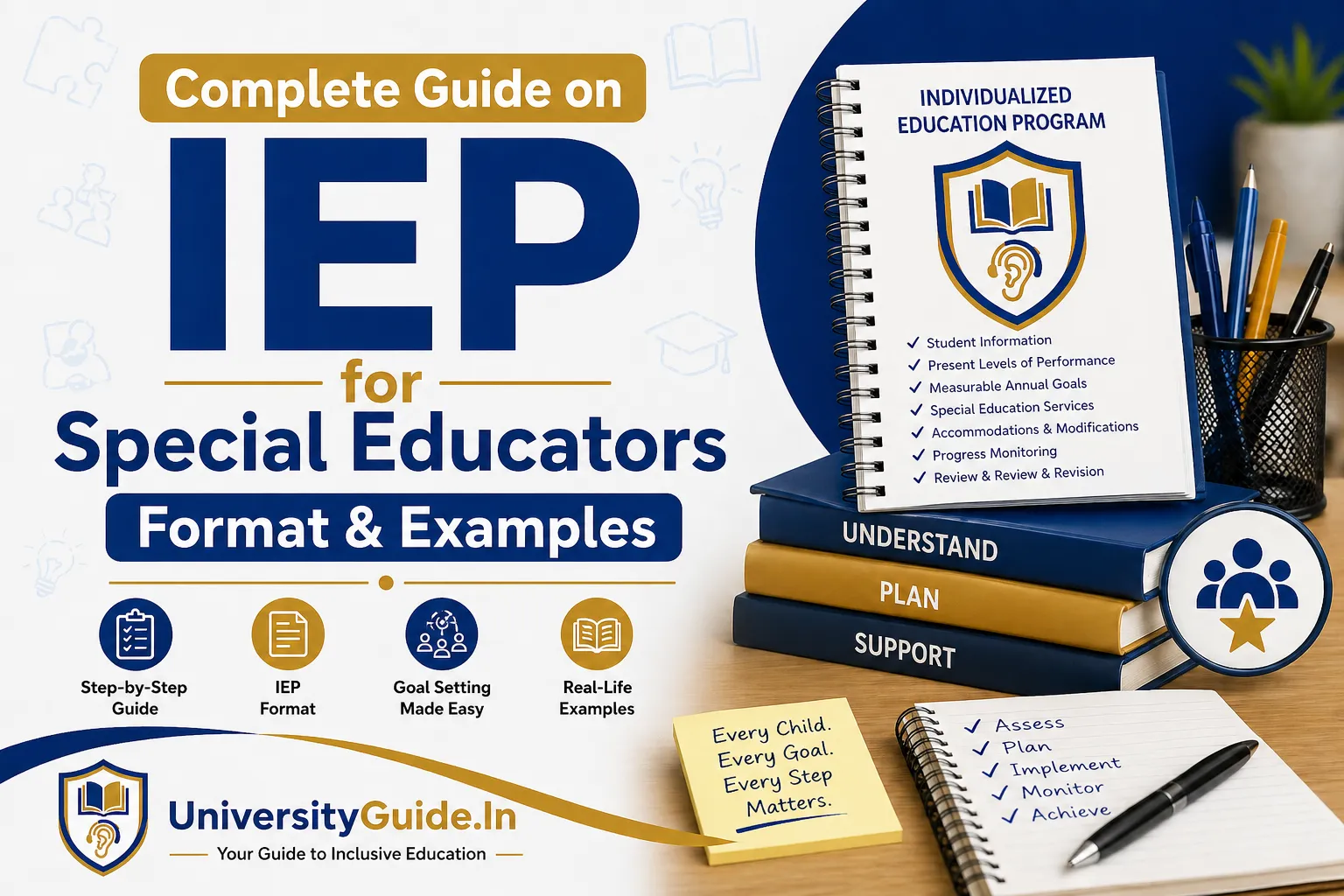
If you are pursuing a B.Ed in Special Education, you have likely heard your professors talk endlessly about the Individualised Education Program. Writing an IEP for Special Educators is not just a passing requirement for your college practical files; it is the absolute foundation of your future career. Whether your specialisation is Hearing Impairment (HI), Visual Impairment (VI), or Intellectual Disability (ID), mastering this document is non-negotiable.
Many students struggle to write a proper IEP. They often confuse “Annual Goals” with “Short-Term Objectives,” or they write goals that cannot be measured. This results in poor marks during the final external practical viva. Furthermore, when you eventually secure a government teaching job in KVS or DSSSB, designing these programs will be your daily responsibility.
In this massive, comprehensive 2000-word guide, we will break down exactly how to write a flawless IEP for Special Educators. We will look at the official RCI format, provide concrete examples for children with Hearing Impairment, and give you a step-by-step blueprint to score maximum marks in your practicals.
1. What Exactly is an IEP?
The term IEP stands for Individualised Education Program. As the name suggests, it is a customised, written educational plan designed for one specific student with special needs. Unlike a regular school syllabus that is made for an entire classroom of 40 children, an IEP is made for an audience of exactly one.
Every child with a disability is unique. Two children with exactly 70 dB of Hearing Loss might have completely different language skills, family backgrounds, and learning speeds. Therefore, a generic lesson plan will fail. An IEP for Special Educators serves as a legal and educational roadmap that outlines where the child currently is academically, where they need to be in one year, and exactly how the teacher will help them get there.
Under the Rights of Persons with Disabilities (RPWD) Act 2016, providing individualised support is a statutory right for every child with a recognised disability in India.
2. Why is the IEP Crucial for B.Ed Special Education Students?
During Semester 3 and Semester 4 of your RCI-approved B.Ed Special Education course, you will undergo intensive school internships. You will be assigned to a Special School and an Inclusive School. During this time, the university requires you to create an IEP for the Special Educators’ practical record file.
- External Examiner Viva: When the external examiner comes for your final practical exams, your IEP file is the first thing they will check. They will ask you to explain your baseline assessment and justify the goals you chose for your assigned child.
- Tracking Progress: Without this document, you are shooting in the dark. It allows you to mathematically track a child’s progress over 3 months, 6 months, and 12 months.
- Team Collaboration: The IEP acts as a communication bridge between you, the speech therapist, the audiologist, and the parents.
3. Key Components of an IEP (The RCI Format)
While different schools might have slightly different table designs, every standard IEP for Special Educators must contain the following five critical components. If any of these are missing from your practical file, you will lose marks.
A. Demographic and Background Information
This is the first page of your file. It includes the child’s Name, Age, Gender, Date of Birth, Mother Tongue, and the exact Medical Diagnosis. For a student with Hearing Impairment, you must attach the latest Audiogram report here and mention the degree of hearing loss (e.g., Profound Sensorineural Hearing Loss in both ears).
B. Current Level of Performance (Baseline)
Before you decide where you want the child to go, you must know exactly where they are right now. This is called the baseline. You must assess the child across various domains:
- Academic Level: Can the child read a Class 2-level text? Can they do basic addition?
- Speech & Language: How many words are in their vocabulary? Do they use Indian Sign Language (ISL) or oral speech?
- Social & Behavioural: Does the child throw tantrums? Do they play with other children?
Pro Tip for your File: Do not write vague statements like “The child is weak in English.” Instead, write “The child can identify the English alphabet but cannot read 2-letter sight words.”
C. Annual Goals and Short-Term Objectives
This is the heart of the IEP for Special Educators.
Annual Goals are what you expect the child to achieve in one academic year.
Short-Term Objectives (STOs) are the small, step-by-step milestones required to reach that annual goal.
D. Teaching Strategies and Accommodations
Here, you list exactly how you will teach the child. Will you use Flashcards? Will you use Total Communication (Sign Language + Speech)? What accommodations are required? (e.g., The child must sit in the first row so they can lip-read the teacher clearly).
E. Evaluation and Assessment
How will you know if the child has learned the skill? You must specify the testing method. Will you use a written test, a verbal response, or an observation checklist?
4. Step-by-Step Guide: How to Write an IEP for Special Educators
Writing your first practical file can be overwhelming. Follow this 5-step blueprint to write a perfect document.
Step 1: Conduct Thorough Observation and Assessment
Do not start writing on day one. Spend at least one week just observing your assigned student. Use standardised tools if available. For Hearing Impairment, use the Receptive and Expressive Language Assessment tools. Talk to the child’s parents to understand their home environment.
Step 2: Convene the Multidisciplinary Team
A true IEP for Special Educators is never written alone. In a real-world scenario, you will sit down with the school psychologist, the audiologist, the speech-language pathologist (SLP), and the parents. In your college practicals, you must simulate this by mentioning the team members in your report.
Step 3: Draft SMART Goals
The biggest mistake B.Ed students make is writing bad goals. Your goals must be SMART:
- Specific: What exactly will the child do?
- Measurable: How will you measure it? (e.g., 8 out of 10 times).
- Attainable: Is it realistic for the child’s disability level?
- Relevant: Does the child actually need this skill for daily life?
- Time-Bound: By what date will they achieve this?
Step 4: Implement the Teaching Plan
Once the IEP is written and signed by your college supervisor, you must execute it. Write down your daily lesson plans, aligning with the short-term objectives. If your objective is teaching “Names of Fruits,” your lesson plans for that week must revolve around fruits using real models (concrete objects) and flashcards.
Step 5: Review and Revise (Quarterly)
An IEP is a living document. Every three months, you must test the child. If the child achieved the goal faster than expected, you write a new, harder goal. If the child is failing, you must revise your teaching strategy. Never blame the child; change your method.
5. Sample IEP Goal for Hearing Impairment (HI)
To make this guide highly practical, let us look at a real-world example of how an IEP for Special Educators’ goals should be structured in your B.Ed record file.
| Sample IEP Goal Structure (Language Domain) | |
|---|---|
| Current Level of Performance: | Ravi (Age 7, Severe HI) can point to objects when shown a picture but cannot express his needs using complete sentences. His expressive vocabulary is currently 20 words. |
| Annual Goal: | By the end of the academic year, Ravi will use a combination of Indian Sign Language (ISL) and spoken words to form simple 3-word sentences to express his daily needs with 80% accuracy. |
| Short-Term Objective 1: | By October, Ravi will correctly sign and say the names of 10 common food items when hungry, in 4 out of 5 observed opportunities. |
| Short-Term Objective 2: | By December, Ravi will combine an action verb with a noun (e.g., “Give Apple” or “Want Water”) using signs, with 80% accuracy. |
| Teaching Strategy / TLM: | Use of visual schedules, real food items (Concrete to Abstract teaching maxim), and positive reinforcement (giving the food item immediately when he signs correctly). |
| Evaluation Method: | Weekly Teacher Observation Checklist and Parent Feedback Form. |
6. Common Mistakes to Avoid in Your Practical Records
Examiners deduct marks rapidly when they see these specific errors in an IEP for Special Educators:
- Writing “Dead-End” Goals: A goal like “The child will understand Science” is terrible. You cannot measure “understanding.” Instead, write, “The child will identify 5 parts of a plant.”
- Ignoring the Parents: The RPWD Act mandates that parents are equal partners in the IEP process. If your practical file does not have a section for “Parental Involvement” or “Home Training Plan,” it is incomplete.
- Confusing Accommodations with Modifications:
Accommodation: Changing HOW the child learns (e.g., giving extra time in an exam, or providing a sign language interpreter).
Modification: Changing WHAT the child learns (e.g., giving the child a 3rd-grade spelling test while the rest of the class takes a 5th-grade test). Know the difference!
7. The Role of the Special Educator in the Inclusive Setup
In modern 2026 classrooms, inclusive education is the standard. This means a deaf child will sit in the same classroom as normal-hearing children. In this scenario, the IEP for Special Educators takes on a new role. You become a “Resource Teacher.”
You will have to share the IEP with the general subject teachers (like the Math or History teacher) and explain to them how to adapt their lessons. If the History teacher is showing a video about the independence movement, your IEP should mandate that the video must have subtitles for the hearing-impaired student.
8. Frequently Asked Questions (FAQs)
Q1: Is the IEP format same for Hearing Impairment and Intellectual Disability?
Ans: The core structure (Demographics, Baseline, Goals, Evaluation) is exactly the same because it is standardized by the RCI. However, the domains you focus on will change. For HI, you focus heavily on Speech, Language, and Auditory Training. For ID, you focus heavily on Activities of Daily Living (ADL) like brushing, dressing, and functional academics.
Q2: How many IEPs do I need to write for my B.Ed Special Education practicals?
Ans: This depends slightly on your university. However, generally, under the RCI syllabus, you are required to prepare and execute at least TWO complete IEPs—one during your Special School internship and one during your Inclusive School internship.
Q3: What if the child does not achieve the Annual Goal at the end of the year?
Ans: This is a very common interview/viva question! If the child fails to achieve the goal, the IEP team must meet to find out why. Was the goal too difficult? Was the child frequently absent? Was the teaching method wrong? You then rewrite the goal to make it more achievable. The IEP is flexible.
Q4: Can parents reject an IEP?
Ans: Yes, parents must sign the IEP for it to be implemented. If they disagree with the goals or the teaching methods, they have the right to ask for a revision.
Conclusion
Mastering the art of writing an IEP for Special Educators will transform you from an average B.Ed student into a highly professional and competent teacher. It teaches you to look at a child not for their limitations, but for their exact, measurable potential.
When preparing your practical files, do not copy blindly from your seniors. Spend time with your assigned student, use proper standardised assessments to find their baseline, and draft SMART goals that will actually improve their life.
We hope this comprehensive guide has cleared all your doubts regarding practical records. Be sure to check out our other articles on Lesson Plan formats and Audiology records to complete your entire practical portfolio. Wishing you the best of luck for your external viva and your future teaching career!