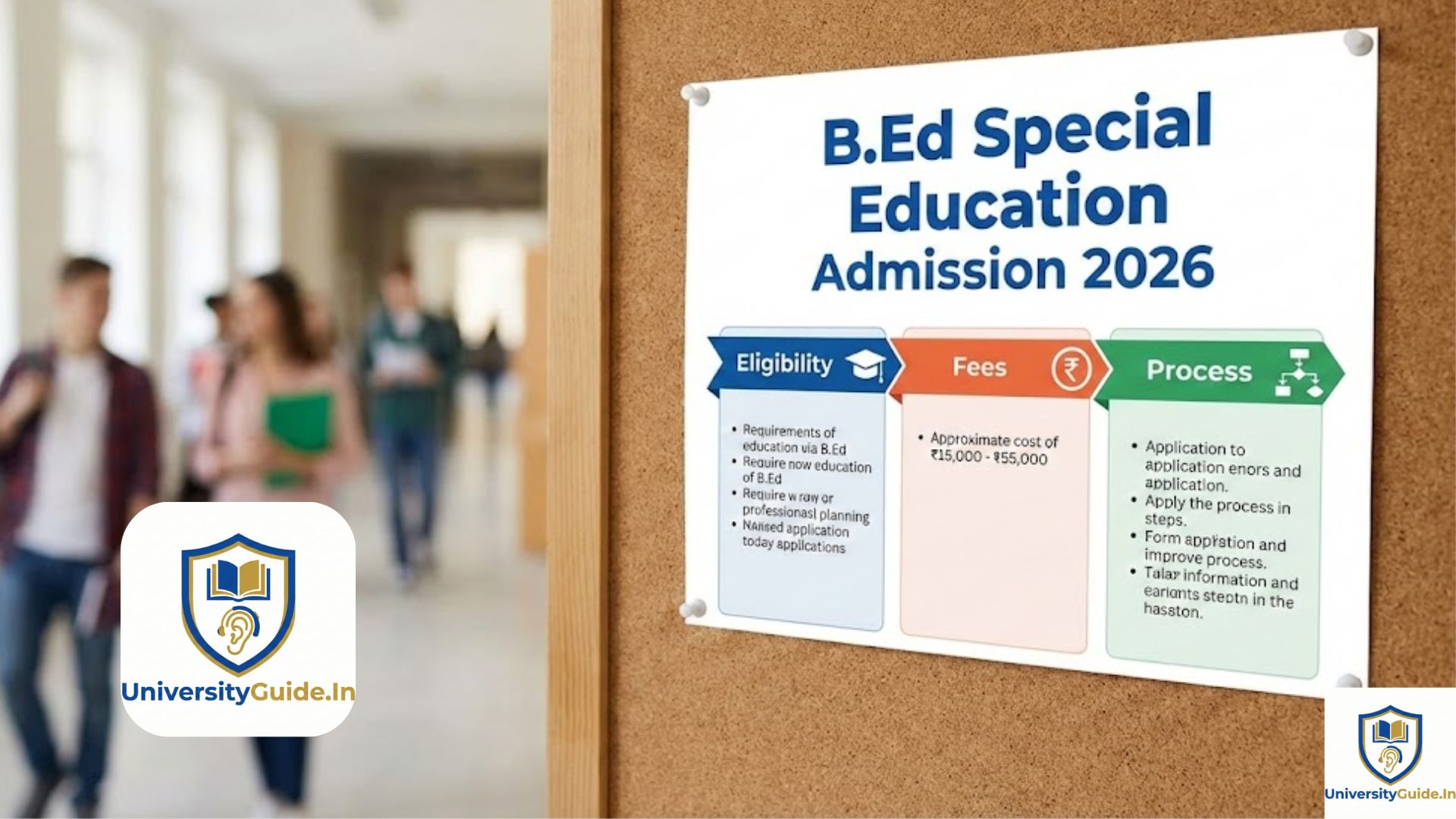
Are you planning to build a noble, secure, and high-paying career by becoming a Special Educator? If so, securing your B.Ed Special Education Admission 2026 is the absolute most important first step you will take.
With the Indian government strictly implementing inclusive education policies under the National Education Policy (NEP 2020), the demand for RCI-certified special teachers is at an all-time high. Every government and private school is now legally mandated to have special educators on their payroll. However, despite this massive demand, thousands of students get confused every year about the admission rules, which entrance exams to write, and how to select a genuine college.
In this massive, comprehensive 2000-word guide, we at University Guide will explain the step-by-step admission process, exact eligibility criteria, entrance exam details, and the fee structure for the B.Ed Special Education course in India. We will also help you choose the best specialisation for your future career.
1. What is the Eligibility for B.Ed Special Education Admission 2026?
Before you fill out any application forms or pay any fees, you must ensure that you meet the strict basic qualifications set by the Rehabilitation Council of India (RCI). The RCI is the supreme governing body for this course, and if you do not meet their criteria, your degree will be considered invalid.
A. Basic Educational Qualification
B.Ed is a postgraduate-level professional teaching degree. Therefore, you cannot apply directly after your 12th standard. You must hold a valid Bachelor’s Degree (such as B.A, B.Sc, B.Com, BBA, BCA, or B.Tech) or a Master’s Degree in Sciences, Social Sciences, Humanities, or Commerce from a recognised university.
B. Minimum Marks Required in Graduation
The percentage required in your graduation varies slightly depending on your category and your academic background:
- General Category Students: You must have secured a minimum of 50% aggregate marks in your Bachelor’s or Master’s degree.
- Engineering / Technology Students (B.Tech / B.E): If you are an engineering graduate with a specialisation in Science and Mathematics, the RCI requires you to have a minimum of 55% aggregate marks to be eligible.
- Reserved Categories (SC / ST / OBC / PWD): The government provides a relaxation of 5% in the minimum qualifying marks for candidates belonging to reserved categories. This means reserved category students need only 45% aggregate marks (or 50% for B.Tech students from reserved categories).
2. The Admission Process: How to Apply Successfully?
The B.Ed Special Education Admission 2026 process is not centralised for the whole country. It varies heavily depending on the state you live in and the university you wish to join. Generally, the admission process happens through one of the following three methods:
Method A: Through State-Level Entrance Exams
Most state governments conduct a massive common entrance test for all B.Ed admissions (both General B.Ed and Special B.Ed). This is the safest and most standard route to take.
- Examples of State Exams: AP EdCET (Andhra Pradesh), TS EdCET (Telangana), UP B.Ed JEE (Uttar Pradesh), PTET (Rajasthan), and MAH B.Ed CET (Maharashtra).
- How it works for Special Education: You write the same entrance exam as everyone else. However, when you pass the exam and sit for the online web counselling, you must specifically select “B.Ed Special Education (Hearing Impairment/Visual Impairment/Intellectual Disability)” from the dropdown menu of preferred methodologies and colleges.
Method B: University-Specific Entrance Exams
Many top-tier central and state universities do not participate in the state-level exams; they conduct their own independent entrance tests specifically for their campus seats.
- Top Universities: Delhi University (DU B.Ed), Banaras Hindu University (BHU), Guru Gobind Singh Indraprastha University (GGSIPU), and various State Open Universities (like Netaji Subhas Open University or MPBOU for distance mode).
- How to apply: You need to actively monitor the specific university’s official website around April or May 2026, fill out their dedicated application form, and clear their specific entrance test.
Method C: Direct Admission (Merit-Based or Management Quota)
Some private colleges offer direct admission based solely on your graduation percentage without requiring an entrance exam. While this is easier, you must be extremely cautious. Always check if the private college has a valid, up-to-date RCI approval for the 2026-2028 batch. If the college loses its RCI approval, your two years of hard work and money will be wasted, and you will never get a government job.
3. Course Duration, Modes of Study, and Fee Structure
The B.Ed Special Education program is a rigorous, highly specialised professional course designed to turn you into a clinical educator.
Course Duration
The course duration is exactly 2 Years, which is divided into 4 Semesters. You will have a mix of heavy theoretical exams and intensive practical internships in both Special Schools and Inclusive Schools.
Mode of Study (Regular vs. Distance)
You can pursue this course in two modes, but the rules for Distance Education are very strict.
- Regular Mode (Face-to-Face): This is the standard daily college format open to any graduate who clears the entrance exam.
- Distance Mode (ODL): Open and Distance Learning is NOT open to everyone. According to RCI rules, to get B.Ed Special Education Admission 2026 in distance mode, you must either be an existing RCI-registered Diploma holder (D.Ed Spl Ed) OR you must be a biological parent of a child with a certified disability. General graduates cannot do this course via distance education.
Expected Course Fees (For the Full 2 Years)
The fee structure varies drastically between government campuses and private institutions.
- Government Colleges / University Campuses: These are highly subsidised. The total fee for two years usually ranges from ₹15,000 to ₹30,000. Because the fees are so low, the competition for these seats in the entrance exams is brutal.
- Private RCI-Approved Colleges: In private colleges, the fees are regulated by the state government, but are still much higher. Expect to pay anywhere from ₹80,000 to ₹1,50,000 for the total two-year course, depending on the state and the college’s infrastructure.
- Hidden Costs: Always budget an extra ₹5,000 to ₹10,000 for practical record books, uniform costs, and transportation during your school internship programs in Semesters 3 and 4.
4. How to Check if a College is RCI Approved? (Crucial Step)
We cannot stress this enough: This is the most important step before confirming your B.Ed Special Education Admission 2026. If the college is approved by the NCTE but NOT by the RCI, the degree is useless for special educator jobs.
Follow these exact steps to verify a college:
- Visit the official Rehabilitation Council of India website at www.rehabcouncil.nic.in.
- Look for the section titled “Approved Institutes” or “List of Recognised Institutions.”
- Download the PDF list for the academic session 2026-2027. (Do not look at the 2023 or 2024 lists, as colleges frequently lose their approvals.
- Search for your target college’s name in the PDF.
- Verify two things: First, ensure they have approval specifically for the B.Ed.Spl.Ed.(HI) or your chosen disability course. Second, check their approved intake capacity (usually exactly 30 seats per batch). If a college offers you the 31st seat, it is an illegal admission.
5. Which Specialisation is Best: HI, VI, or ID?
When filling out your B.Ed Special Education Admission 2026 forms, you will be forced to choose a disability specialisation. Students are often deeply confused about which path offers the best career scope.
Hearing Impairment (HI)
This is arguably the most balanced and highly sought-after specialisation. You will learn Indian Sign Language (ISL), how to read medical Audiograms, and how to conduct Speech Therapy basics. The job scope for HI specialists in both government schools (like DSSSB and KVS) and private clinical settings is excellent. At University Guide, we highly recommend the HI specialisation.
Visual Impairment (VI)
If you choose VI, your primary technical skill will be mastering the Braille reading and writing system, along with Orientation and Mobility training. While noble, the number of exclusive vacancies for VI educators is sometimes slightly lower than HI or ID.
Intellectual Disability (ID) / Mental Retardation (MR)
This specialisation focuses heavily on psychology, behaviour modification, and teaching Activities of Daily Living (ADL). You will work with children who have Down Syndrome, Autism, or severe cognitive delays. It is a highly demanding job emotionally, but the private sector demand for ID specialists is absolutely massive.
6. Mandatory Documents Required for Counselling and Admission
Once you clear your entrance exam, you will be called for document verification. To secure your B.Ed Special Education Admission 2026 smoothly, start gathering these original documents right now:
- 10th Standard (SSC) Marksheet and Passing Certificate (for Date of Birth proof).
- 12th Standard (HSC / Intermediate) Marksheet.
- Graduation Marksheets (All 3 or 4 years) and Original Degree / Provisional Certificate.
- Transfer Certificate (TC) and Migration Certificate from your last attended university.
- Entrance Exam Rank Card and Hall Ticket.
- Caste Certificate (if claiming SC/ST/OBC reservation).
- Income Certificate (mandatory if you plan to apply for state fee reimbursement or scholarships).
- Recent Passport Size Photographs.
7. Scholarship Options for B.Ed Special Education Students
Do not let the high fees of private colleges deter you from pursuing this career. The government provides massive financial support to students entering this field.
- State Government Fee Reimbursement: States like Andhra Pradesh (Jagananna Vidya Deevena) and Telangana (ePASS) offer full or partial fee reimbursement for eligible low-income students who secure seats through the state EdCET exams.
- National Scholarship Portal (NSP): Minority students, single girl children, and students with disabilities can apply for lucrative central government scholarships through the NSP portal.
Frequently Asked Questions (FAQs)
Q1: Can I get B.Ed Special Education Admission 2026 directly after my 12th class exams?
Ans: No. B.Ed is a post-graduate level professional course. You must complete your 3-year or 4-year Graduation degree first. If you have just passed your 12th standard and want to enter this field immediately, you should apply for the D.Ed Special Education (Diploma) course, which is done through the national level AIOAT entrance exam.
Q2: Is the syllabus for B.Ed Special Education much harder than General B.Ed?
Ans: It is more technical, but not necessarily harder. You have to study normal teaching subjects (like Pedagogy of Math or Science), but you also have to study medical subjects like the Anatomy of the Ear, Audiology, and Child Psychology. If you are passionate about helping children, you will find the syllabus incredibly interesting.
Q3: After taking admission, can I change my specialization from HI to ID in the second year?
Ans: No. Once you select a specialization during your initial B.Ed Special Education Admission 2026 counselling, it is locked in for the entire two years. The RCI does not allow mid-course specialization changes because the practical training required for each disability is completely different.
Q4: Will a B.Ed Special Education degree allow me to teach normal children?
Ans: Yes! A landmark judgment by the Central Administrative Tribunal (CAT) declared that B.Ed Special Education is equivalent to General B.Ed. After completing this degree, you can confidently apply for regular TGT subject teacher jobs in normal schools, as long as you clear the CTET or State TET exams.
Conclusion
Securing your B.Ed Special Education Admission 2026 is the brilliant first step toward a career that offers a rare combination of high government salary, job security, and immense emotional satisfaction. Make sure you focus on scoring well in your final graduation exams, prepare intensely for your state’s EdCET or university entrance exam, and absolutely always verify the RCI approval of your chosen college.
If you have any doubts regarding the entrance exam dates, counselling procedures, or how to prepare for the syllabus, please browse the other comprehensive guides available here on the University Guide portal. We wish you the best of luck with your admissions and your future career as a Special Educator!