Many students across India constantly ask, “Is choosing a career after B.Ed Special Education Hearing Impairment actually a good option?”
The simple and straightforward answer is an absolute YES. In fact, right now, the competition in the Special Education field is significantly lower than in the General B.Ed sector. Because the awareness of this specialised degree is still growing, the demand for qualified Special Educators—especially those who specialise in Hearing Impairment (HI)—is increasing much faster than the supply of trained teachers.
If you have recently graduated or are planning to take admission into an RCI-approved college, you are making a very safe and lucrative career choice. In this massive, comprehensive 2000-word guide, we will explain everything you need to know about building a successful career after B.Ed Special Education Hearing Impairment. We will cover upcoming government vacancies, the exact salary packages you can expect, and the vast opportunities waiting for you in the private and clinical sectors.
Why Choose a Career After B.Ed Special Education Hearing Impairment?
The landscape of Indian education is changing rapidly. According to the mandate of the National Education Policy (NEP 2020) and the Rights of Persons with Disabilities (RPWD) Act 2016, every single school in India—whether government or private—must practice inclusive education. This means they are legally required to hire special educators to support children with disabilities. This legal backing guarantees that the number of jobs will keep increasing every single year.
As a specialist holding a degree in Hearing Impairment (HI), you possess a unique and highly respected advantage. You are not just a traditional classroom teacher who reads from a textbook; you are a multi-skilled professional. During your two-year degree, you are rigorously trained in:
- Indian Sign Language (ISL): The ability to communicate fluently using your hands and facial expressions.
- Audiometry and Hearing Tests: The technical ability to read medical audiograms and manage complex hearing aids and cochlear implants in a classroom setting.
- Speech Training and Auditory Verbal Therapy: The clinical skills required to teach a deaf child how to articulate sounds and understand spoken language.
Because you hold these clinical and educational skills, a career after B.Ed Special Education Hearing Impairment opens doors not just in traditional schools, but also in NGOs, hospitals, and private therapy clinics.
1. Government Jobs for Special Educators (The Ultimate Goal)
For a majority of Indian students, securing a government job is the ultimate dream. The government sector offers unparalleled job security, handsome salaries under the 7th Pay Commission, and excellent retirement benefits. Let us break down the top government sectors that actively recruit special educators.
A. Central Government Schools (KVS & NVS)
The Kendriya Vidyalaya Sangathan (KVS) and Navodaya Vidyalaya Samiti (NVS) are the most prestigious school chains in India. They release massive recruitment notifications for “Special Educator” posts on a regular basis to cater to inclusive classrooms across the country.
- Eligibility: To apply, you must have your B.Ed Special Education degree, a valid RCI registration number, and you must have cleared CTET (Paper 2).
- Selection Process: An all-India computer-based written test followed by a personal interview and teaching demonstration.
- Salary: You will join as a TGT (Trained Graduate Teacher). Your starting in-hand salary will range from ₹60,000 to ₹65,000 per month, depending on the city you are posted in.
B. Delhi Government Schools (DSSSB)
If you want a career after B.Ed Special Education Hearing Impairment with a fixed posting in a metropolitan city, the Delhi Subordinate Services Selection Board (DSSSB) is your best target. The Delhi government is famous for strictly enforcing inclusive education and frequently recruits thousands of special educators at once.
- Eligibility: B.Ed Special Education + CTET Paper 2. (Note: Delhi government often gives age relaxation for women candidates).
- Salary: TGT Special Education Teachers in Delhi draw a very handsome salary of approximately ₹65,000+ per month, along with excellent medical facilities.
C. State Government Jobs (DSC / TRT)
Almost every state government in India, including Andhra Pradesh, Telangana, Uttar Pradesh, and Rajasthan, conducts its own Teacher Recruitment Test (TRT) or District Selection Committee (DSC) exams.
- Dual Advantage: Thanks to recent rulings by the Central Administrative Tribunal (CAT), candidates with a B.Ed Special Education degree are considered equivalent to General B.Ed candidates. This means you can apply for the dedicated “Special School Assistant” vacancies AND the regular “General School Assistant” vacancies, effectively doubling your chances of getting a government job!
D. Samagra Shiksha Abhiyan (SSA)
The SSA is a massive central government program aimed at universalizing elementary education. They frequently hire special educators on a contractual basis at the block or district level. While it is contractual, the pay is decent (around ₹20,000 to ₹25,000), and the experience gained is highly valuable for your resume.
2. Private Sector and Clinical Opportunities
Not everyone wants to wait years preparing for a government competitive exam. If you want to start earning immediately, the private sector offers a brilliant career after B.Ed Special Education Hearing Impairment.
A. Inclusive International Schools
Top-tier international schools (affiliated with CBSE, ICSE, or IB boards) in cities like Hyderabad, Bangalore, and Delhi are legally required to maintain inclusive classrooms. They heavily recruit “Resource Teachers” or “Shadow Teachers” to help children with hearing loss or learning disabilities integrate with normal children. The starting salary ranges from ₹25,000 to ₹40,000 per month, and the working environment is usually world-class.
B. Special Schools and NGOs
There are hundreds of dedicated Special Schools for the Deaf run by reputed NGOs across India. These institutes strictly hire RCI-registered special educators. While the starting salary might be slightly lower (₹15,000 to ₹25,000), the job satisfaction of helping profoundly deaf children is immense.
C. Clinical Settings and Hospitals
Because your specialisation is Hearing Impairment, you have studied Audiology and Speech Therapy basics. You can work in the Rehabilitation or ENT departments of large hospitals or Child Development Centres. Your role would be a Developmental Therapist, helping young children adjust to their new cochlear implants.
D. Freelance Sign Language Interpreter
If you master Indian Sign Language (ISL) during your degree, you can work as a freelance interpreter. News channels, corporate conferences, and government meetings often hire interpreters on an hourly basis, paying anywhere from ₹500 to ₹1500 per hour.
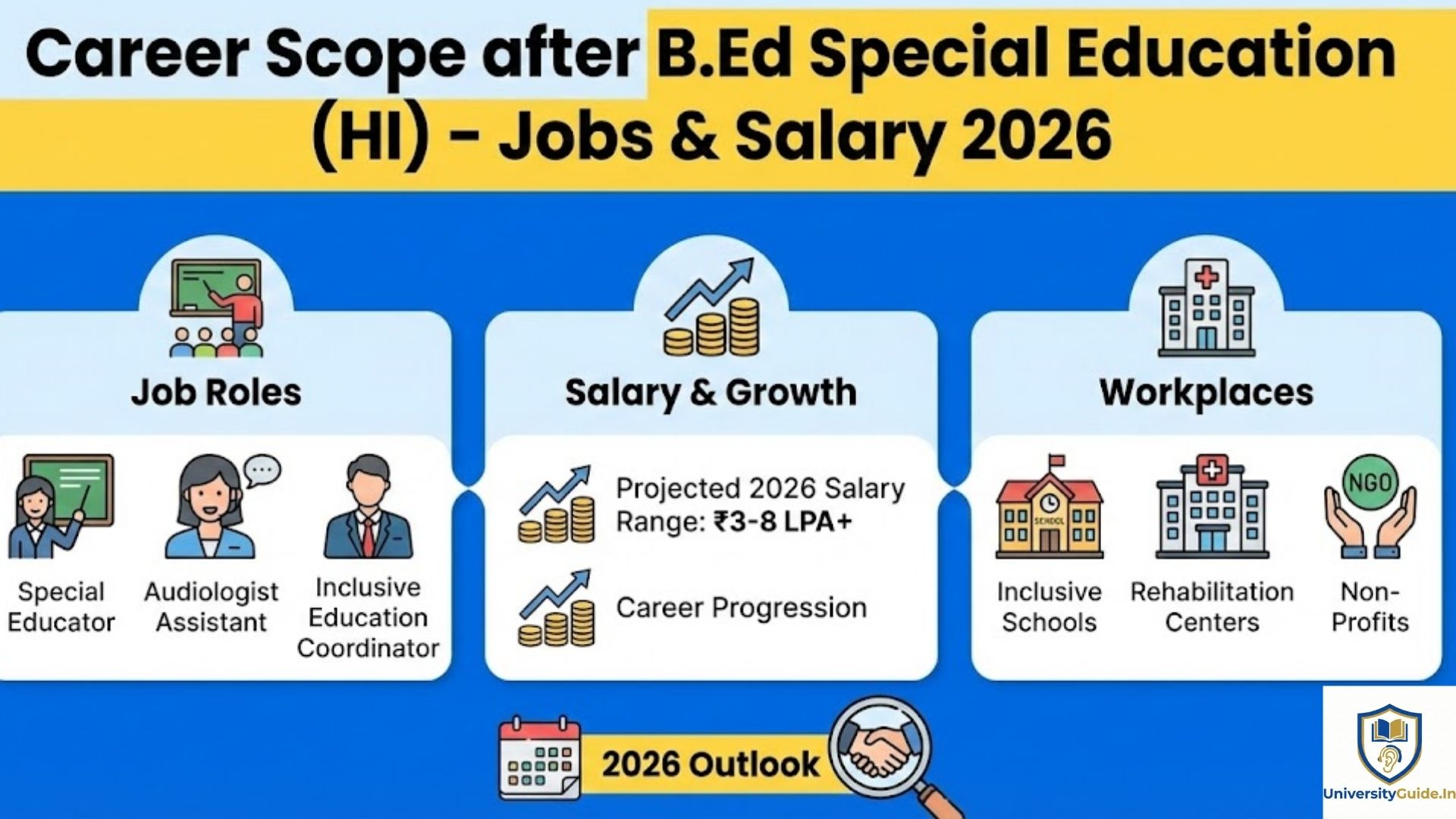
3. Expected Salary of a Special Educator in India (2026)
Money is a crucial factor when choosing any profession. The salary in a career after B.Ed Special Education Hearing Impairment depends heavily on whether you choose the government or private route, and the specific state you work in. Below is a detailed breakdown of the expected remuneration.
| Job Profile / Sector | Expected Starting Salary (Per Month) |
|---|---|
| Central Govt Teacher (KVS/NVS TGT) | Basic ₹44,900 + DA + HRA (In-hand approx ₹60,000 – ₹65,000) |
| State Govt Teacher (DSC / TRT) | ₹35,000 – ₹45,000 (Varies strictly by State Pay Commission) |
| SSA Contractual Special Educator | ₹20,000 – ₹25,000 (Fixed consolidated pay) |
| Private International School Teacher | ₹25,000 – ₹40,000 (Depends on experience and city) |
| Special School Teacher (NGO) | ₹15,000 – ₹25,000 |
| Home Tutor for Special Needs | ₹500 – ₹1000 per hour (Freelance extra income) |
Pro Tip for Extra Income: Special education home tutoring is in massive demand. Parents of children with hearing impairment or autism are always looking for trained professionals to teach their kids after school hours. By taking just two home tuitions on weekends, you can easily add an extra ₹15,000 to your monthly income.
4. Crucial Steps to Start Your Career After B.Ed Special Education Hearing Impairment
Just passing your university exams and holding the B.Ed certificate in your hand is not enough to get a job. You must fulfil two major legal and professional requirements to activate your career.
Step 1: The RCI Registration (CRR Number)
The Rehabilitation Council of India (RCI) is the governing body for all special education courses in the country. Working as a special educator without an RCI license is illegal. Immediately after your university results are declared, you must apply online on the RCI portal to get your name added to the Central Rehabilitation Register.
Once approved, you will receive a unique CRR Number. You must mention this number on every job application. Furthermore, to keep this license active, you must attend Continuing Rehabilitation Education (CRE) programs and renew your registration every 5 years.
Step 2: Clearing the CTET Exam
As discussed earlier, if you want a government career after B.Ed Special Education Hearing Impairment, passing the Central Teacher Eligibility Test (CTET) is strictly mandatory. You do not need to write a separate exam; you will write the exact same CTET Paper 2 as regular B.Ed students. To learn more about how to pass this exam, you can read our detailed CTET for Special Educators Preparation Guide.
5. Higher Studies Options for Career Growth
If you do not want to stop at teaching school children and wish to climb the academic ladder, there are excellent higher education pathways available for you.
- M.Ed Special Education (HI): Pursuing a Master of Education in Special Education makes you eligible to become an Assistant Professor or Lecturer in B.Ed colleges. Since there is a massive shortage of qualified college faculty in this field, M.Ed graduates get hired very quickly.
- PhD in Special Education: If you are interested in creating new teaching methodologies or developing new sign language resources, a PhD opens doors to high-level research roles and government policy-making boards.
- M.A. in Psychology: Many special educators choose to pursue a Master’s degree in Clinical or Child Psychology via distance education. Having dual degrees in Special Education and Psychology makes you a highly sought-after School Counsellor.
For more official updates on educational policies and teacher qualifications, you can always refer to the National Council for Teacher Education (NCTE) official website.
Frequently Asked Questions (FAQs)
Q1: Is CTET Paper 1 or Paper 2 mandatory for a career after B.Ed Special Education Hearing Impairment?
Ans: Because you hold a Bachelor’s degree (B.Ed), you are trained to teach upper primary classes. Therefore, clearing CTET Paper 2 is mandatory for you to apply for TGT (Trained Graduate Teacher) posts in government schools. Paper 1 is only for D.Ed (Diploma) candidates.
Q2: Can B.Ed Special Education students apply for General Teacher posts in normal schools?
Ans: Yes, absolutely! According to recent orders from the Central Administrative Tribunal (CAT) and NCTE guidelines, a B.Ed in Special Education is considered legally equivalent to a General B.Ed degree. You are fully eligible to apply for normal TGT subject teacher jobs in government schools, provided you clear the required TET exams.
Q3: Is the job of a Special Educator stressful?
Ans: Like any teaching profession, it requires a lot of patience. Teaching children with hearing impairment involves using sign language, extensive visual aids, and highly repetitive teaching methods. Sometimes progress can be slow. However, the emotional satisfaction of helping a deaf child speak their first word or pass their first exam is unmatched by any other corporate job.
Conclusion
Choosing a career after B.Ed Special Education Hearing Impairment is one of the smartest and most noble decisions you can make in 2026. With the strict implementation of inclusive education policies across India, the demand for qualified special educators is currently much higher than the actual supply of teachers.
If you focus deeply on your studies, master Indian Sign Language, immediately register for your RCI CRR number, and clear your CTET exam, you can easily secure a highly respected, high-paying government job within 1 to 2 years of graduation.
We hope this guide has cleared all your doubts about your future career path. For more study materials, previous year question papers, and syllabus updates, keep visiting the University Guide portal. We wish you the very best in your journey to changing the lives of children with special needs!
1 thought on “Career After B.Ed Special Education Hearing Impairment: Jobs & Salary”