
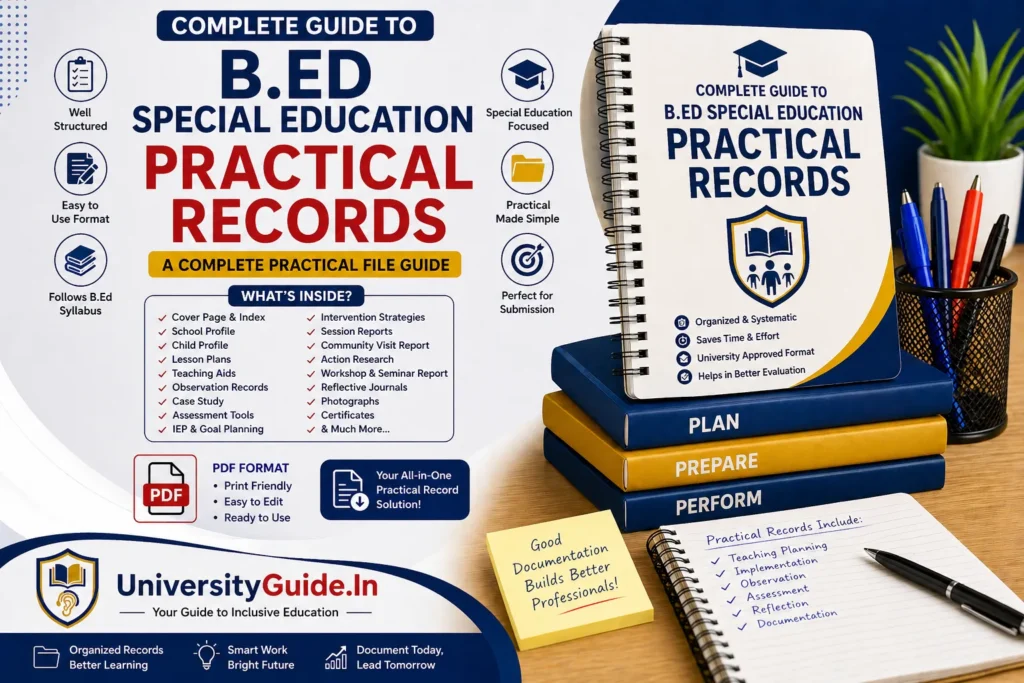
Welcome to the ultimate resource for B.Ed students. If you are pursuing a degree in this noble field, you already know that passing your theory exams is only half the battle. The real test of your teaching skills, patience, and clinical knowledge happens during your university practical exams. To pass these exams, you are expected to painstakingly maintain nearly 10 to 12 different B.Ed Special Education Practical Records over your two-year course.
For many student-teachers, these record files are a massive source of stress. Most students struggle because standard B.Ed textbooks do not teach you how to write a clinical Case Study, how to plot an Audiogram, or how to design a specialized Lesson Plan for a child with Hearing Impairment. Copying blindly from seniors often leads to poor marks because external examiners can easily spot duplicate data.
Do not worry. In this massive, 2000-word comprehensive guide, we will cover every single file you need to submit for your Rehabilitation Council of India (RCI) practical exams. We will break down the exact structure of these B.Ed Special Education Practical Records, tell you what the external examiners look for, and provide you with top viva questions to help you secure a distinction.
Why Are B.Ed Special Education Practical Records So Crucial?
You might wonder why the RCI forces you to write thousands of pages by hand. Unlike general B.Ed courses, where your only job is to stand in front of a class and teach a subject like Mathematics or History, Special Education demands much more. In this field, you are functioning as a “Therapist-Teacher.”
- External Examiner Scrutiny: During your final practical exams, an external examiner appointed by the university will visit your college. They will not just watch you teach; they will spend hours meticulously checking your B.Ed Special Education Practical Records.
- Viva Voce Dependency: Your entire Viva (oral interview) marks depend entirely on what you have written in your Case Study and IEP files. If your files are weak, your interview will be very difficult.
- Proof of Competence: These records are the ultimate legal and educational proof that you actually know how to handle a child with special needs in a real, inclusive classroom environment.
1. The Individualised Education Plan (IEP) Record File
The Individualised Education Program (IEP) is the absolute heart of Special Education. It is a legally binding document where you plan highly specific educational goals for one specific student based on their unique disability and needs. Your IEP file is the most important book in your collection of B.Ed Special Education Practical Records.
What must you write in the IEP Record?
- Demographic and Medical Data: You must start with the child’s Name, Age, Gender, Mother Tongue, and the exact Medical Diagnosis (e.g., Bilateral Profound Sensorineural Hearing Loss). You must attach their audiogram report here.
- Current Level of Performance (Baseline): You cannot set a goal if you do not know where the child stands today. Assess what the child can do right now. Do not use vague words. Instead of writing “The child is weak in English,” write “The child can match pictures but cannot independently write 3-letter words.”
- Goal Setting (The SMART Framework):
- Annual Goal: What will the child achieve in one year? (e.g., “The child will learn and independently express 50 new vocabulary words using Indian Sign Language by the end of the academic year.”)
- Short Term Objective (STO): Break the annual goal into small pieces. (e.g., “The child will learn the names of 5 fruits in 2 weeks with 80% accuracy.”)
- Evaluation and Grading: Did the child actually achieve the goal you set? You must mark their progress in your file using specific prompts: Independent (I), Verbal Prompt (VP), or Physical Prompt (PP).
2. The Case Study Record File
A Case Study is a deep, clinical investigation into the life of a student with a disability. You are required to visit the child’s home, interview their parents, and observe the child across multiple settings. This file tests your empathy and your analytical skills.
Structure of a High-Scoring Case Study:
- Family History (Genogram): Is there a history of deafness or intellectual disability in the family? You must strictly ask about Consanguinity (marriage between blood relatives, like cousins), as it is a major cause of genetic hearing loss.
- Medical History: You must ask the mother about her pregnancy. Was she ill? Did she take unprescribed medicines? Was it a normal delivery or a premature birth? Did the baby cry immediately after birth?
- Developmental Milestones: At what exact age did the child sit, walk, and start babbling? For deaf children, you will almost always note a severe delay in the speech and language milestones.
- Problematic Behaviour: Does the child hit others out of frustration? Is the child excessively shy or hyperactive in the classroom?
- Educational Recommendations: Conclude your file with professional advice for the parents and the regular classroom teacher based on your findings.
3. Lesson Plan Records for Hearing Impairment
Teaching a deaf child is vastly different from teaching a hearing child. You cannot just stand at the blackboard and lecture; you have to visually show the concept. In your B.Ed Special Education Practical Records, your lesson plan file will be the thickest, containing nearly 40 to 50 individual plans.
Types of Lesson Plans Required:
A. Curricular Lessons (Subject Teaching)
These are standard 45-minute lessons where you teach regular school subjects like Science, Mathematics, or Social Studies. The catch is that you must write down exactly what Visual Aids (TLM) you will use and how you will adapt the heavy textbook language so a deaf child can understand it.
B. Language Lessons
Deaf children struggle immensely with grammar. In these specific lesson plans, you do not teach facts; you teach sentence structure. Example: Teaching the concept of Prepositions (“On / In / Under”) using a physical toy car and a box.
C. Speech and Auditory Lessons
These are non-curricular plans. Here, your objective is to teach the child how to physically pronounce sounds (Articulation) or how to listen to environmental sounds using their hearing aids. Example: Teaching the child to differentiate between the /ba/ sound and the /pa/ sound using a strip of paper to show airflow from the mouth.
4. Audiology and Speech Record File
This is the most technical and medically oriented file among all your B.Ed Special Education Practical Records. It proves to the examiner that you understand the anatomy of the ear and the machines your students wear.
What you must include in this file:
- Anatomical Diagrams: Hand-drawn, neatly labeled diagrams of the External, Middle, and Inner Ear.
- Pure Tone Audiometry (PTA) Reports: You must paste actual dummy Audiograms into your file and write a paragraph explaining them. You must explain the X (Left Ear) and O (Right Ear) symbols, and calculate the exact degree of loss (Mild, Moderate, Severe, or Profound).
- Hearing Aids & Implants: Draw pictures of Behind-The-Ear (BTE) hearing aids and Cochlear Implants. Write down the troubleshooting steps you will take if a child’s machine stops working in your class.
- Ling 6 Sound Test: You must include a daily tracking sheet showing how your assigned child responds to the six critical speech sounds: /a/, /u/, /i/, /s/, /sh/, and /m/.
5. Psychology Practical Record
As a special educator, you need to understand the cognitive capacity of your students. In this file, you will document the psychological tests you conducted on children during your internship.
Common Psychological Tests used in B.Ed (HI):
- SFB (Seguin Form Board): A simple, non-verbal puzzle test used to check the basic intelligence and motor speed in young children.
- VSMS (Vineland Social Maturity Scale): An interview-based test done with the parents to check if the child is socially independent for their age (e.g., Can they eat alone? Can they dress themselves?).
- DST (Developmental Screening Test): Used to see if the child’s overall growth matches normal expectations for their age group.
6. Observation and Institute Visit Reports
During your two-year course, your college will take you on mandatory field trips to various educational and medical institutes. You must write a detailed, critical report for each visit in your B.Ed Special Education Practical Records.
- Visit to a Special School (HI): Observe the infrastructure. Are the classrooms arranged in a semi-circle so every child can see the teacher’s hands? Is there proper lighting for lip-reading?
- Visit to an Inclusive Mainstream School: Observe how the special child interacts with normal-hearing children. Is the general teacher ignoring the deaf child, or actively including them?
- Visit to a Speech & Hearing Clinic: Document the medical equipment you see, such as soundproof audiometry rooms, tympanometers, and speech therapy mirrors.
7. Internship Records and Daily Diaries (Semester 3 & 4)
This is the “Daily Diary” of your actual teaching practice. During Semesters 3 and 4, you will spend months teaching in real schools. This file tracks your daily survival and growth as a teacher.
- Attendance Register: Must contain the official seal and signature of the school principal where you did your internship.
- Daily Log: A short summary of your day. (e.g., “Today I taught Chapter 4 of EVS to Class 5 and conducted a spelling test.”)
- Reflective Journal: This is highly important. You must write about your failures and how you fixed them. (e.g., “Today I faced a major problem—student Ravi was crying and refused to wear his hearing aid. I solved it by checking the battery and realizing the earmold was too tight.”)
Top 10 Viva Questions for Practical Exams (Prepare These!)
When the external examiner opens your B.Ed Special Education Practical Records, they will cross-question you to ensure you actually wrote the files yourself. Memorize these top 10 frequently asked Viva Voce questions:
- “What is the exact difference between an IEP and a Lesson Plan?”
Answer: An IEP is a long-term plan designed for ONE single student based on individual goals. A Lesson Plan is a short-term, 45-minute daily plan designed to teach the WHOLE class simultaneously. - “What does 60 dB hearing loss mean?”
Answer: It falls under Moderately Severe hearing loss. The child will miss 100% of normal conversational speech without a hearing aid and requires seating in the front row. - “Why is family history so important in your Case Study?”
Answer: It helps us determine the etiology (cause) of the disability. We check for consanguineous marriages to see if the hearing loss is genetic and hereditary, or acquired after birth. - “What is Total Communication?”
Answer: It is an educational philosophy where the teacher uses every available method simultaneously: Speech, Indian Sign Language (ISL), Lip Reading, Gestures, and Writing, to ensure the child understands the message. - “Explain the four main parts of a BTE Hearing Aid.”
Answer: The Microphone (catches sound), the Amplifier (makes sound louder), the Receiver (sends sound into the ear), and the Battery (provides power). - “What is the difference between Formative and Summative evaluation in your lesson plan?”
Answer: Formative evaluation is the quick questions I ask *during* the class to check understanding. Summative evaluation is the final worksheet or exam I give at the *end* of the class or year. - “What is the ‘Speech Banana’?”
Answer: It is a banana-shaped area on an audiogram graph where all the sounds of human conversational speech (like vowels and consonants) are located. - “What does the RPWD Act 2016 say about inclusive education?”
Answer: It legally mandates that all government and recognized private schools must admit children with disabilities without discrimination and provide them with necessary accommodations like ramps and special educators. - “If a child with autism starts throwing a tantrum in your class, what will you do?”
Answer: I will ensure the child’s physical safety, remove any sensory triggers (like loud noises or bright lights), use a calm voice, and redirect their attention to a preferred, soothing activity. - “What are the Ling 6 Sounds and why do we use them?”
Answer: The sounds are /a/, /u/, /i/, /m/, /s/, and /sh/. We use them every morning to quickly check if a child’s hearing aid is functioning across all low, middle, and high frequencies.
For more official guidelines on practical standards, you can refer to the National Board of Examination in Rehabilitation (NBER) portal.
Conclusion: Surviving Your Practical Exams
Maintaining your B.Ed Special Education Practical Records can undoubtedly be tiring. Writing hundreds of pages by hand, drawing diagrams, and filling out observation charts takes up a massive amount of your weekends. However, you must realize that these files are your best resource for learning.
A well-written Case Study will teach you more about human psychology than a whole textbook. A perfectly executed IEP will give you the confidence to walk into any government school or private clinic and immediately start changing a child’s life for the better.
Do not wait until the last month before the exams to start writing. Complete your lesson plans and observation reports daily during your internship. If you keep your records neat, authentic, and clinically accurate, you will easily impress the external examiner and score top marks in your Viva Voce. Bookmark this page, share it with your college batchmates, and best of luck with your practical exams!